
Xiaowen Bai

My research focuses on the molecular and cellular mechanisms underlying neurodevelopmental brain injury, with particular emphasis on anesthesia- and alcohol-induced neurotoxicity. My laboratory integrates mouse models, patient-derived human samples, human induced pluripotent stem cell-derived neural cells, cerebral organoids, single-cell RNA sequencing, and complementary multi-omics approaches to define how non-coding RNAs, mitochondrial dysfunction, redox imbalance, and genetic factors drive cell type-specific injury pathways involved in brain injury and neurodevelopmental disorders. We also extend these studies to stem cell-derived cardiac models to investigate related mechanisms of cardiotoxicity and diabetic injury. Through these studies, we seek to identify clinically relevant biomarkers and therapeutic targets for vulnerable patient populations and to advance translational stem cell-based platforms for disease modeling, drug discovery, and regenerative medicine. This work has been continuously supported by the National Institutes of Health, including PPG, R35, and R01 awards, for more than 25 years.
Research Interests
Research Area 1: Non-coding RNAs, mitochondria, and cell stress-related pathways in neurodevelopmental injury and neurodegeneration
Our research investigates the molecular and cellular mechanisms underlying neurodevelopmental injury, neurodegeneration, and related neurological disorders. In particular, we study how microRNAs, long non-coding RNAs, mitochondria, immediate early genes, and other cell stress-related pathways contribute to brain injury induced by clinically relevant exposures and genetic risk factors, including anesthetics and alcohol. To address these questions, we integrate mouse models, patient-derived human samples, human stem cell-derived brain cells, cerebral organoids, single-cell RNA sequencing, and complementary multi-omics approaches to define disease mechanisms and identify clinically relevant biomarkers and therapeutic targets.
Our research investigates the molecular and cellular mechanisms underlying neurodevelopmental injury, neurodegeneration, and related neurological disorders. In particular, we study how microRNAs, long non-coding RNAs, mitochondria, immediate early genes, and other cell stress-related pathways contribute to brain injury induced by clinically relevant exposures and genetic risk factors, including anesthetics and alcohol. To address these questions, we integrate mouse models, patient-derived human samples, human stem cell-derived brain cells, cerebral organoids, single-cell RNA sequencing, and complementary multi-omics approaches to define disease mechanisms and identify clinically relevant biomarkers and therapeutic targets.
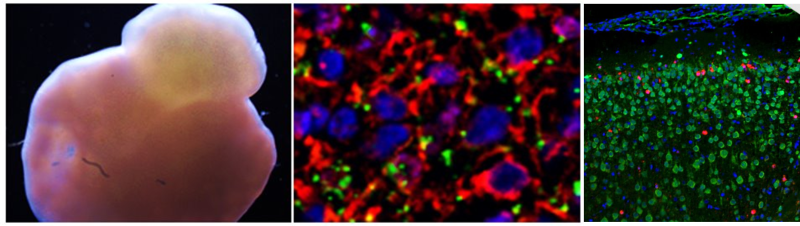
Figure 1. Human induced pluripotent stem cell-derived cerebral organoid (left), neurons within a cerebral organoid (middle), and alcohol-induced cell death (red) in the neonatal mouse brain (right).
Video 1. Live imaging of dynamic mitochondrial movement, fission, and fusion in human stem cell-derived neurons, with mitochondria labeled in red and green.
Research Area 2: Stem cell and organoid biology in disease modeling, tissue regeneration, and drug discovery
My laboratory has developed and validated human iPSC-derived neural cultures and brain organoids as human-relevant platforms for studying neurodevelopmental injury, neurodegeneration, and neurotoxicity, as well as for evaluating drug efficacy and safety. We also investigate stem cell-based approaches for cardiac repair after ischemic and diabetic injury, with particular interest in the mechanisms regulating cell homing, engraftment, survival, and functional integration in vivo.
Video 2. Spontaneous contraction of human iPSC-derived three-dimensional cardiac organoids.
Research Area 3: Injury and protection of cardiac and neuronal cells under diabetic conditions
Hyperglycemia diminishes protective signaling in both cardiac and neuronal cells, increasing vulnerability to injury under diabetic conditions. Our laboratory uses human stem cell-derived cardiac and neural cells, organoids, and mouse models to investigate how diabetes alters cellular injury responses, stress pathways, and survival signaling. These integrated platforms provide a translational framework for identifying mechanisms, biomarkers, and therapeutic targets to improve cardiac and neurological outcomes in diabetes.
Publications:
PubMed Bibliograph
PubMed Bibliograph